


The ultimate Monet road trip in Normandy: 9 days through Giverny, Etretat, Rouen and beyond
Updated: Jun 8
To mark the 100th anniversary of Claude Monet's passing, we took a road trip through Normandy - a region that served as the cradle of the Impressionist movement between the salt-sprayed Alabaster Coast and the quiet reaches of the Seine Valley. Although Monet was born in Paris, he moved to Le Havre as a young boy, and it was here in Normandy that his artistic identity was truly formed. Guided by mentors like Eugene Boudin, he learned to paint in the open air, capturing the landscapes that would define his life's work.
While many art lovers dream of visiting the iconic lily ponds at Giverny, there are plenty of other easily reachable locations that will enable you to extend your trip into a kind of Monet pilgrimage, along the rugged white cliffs, through the medieval streets of Rouen to the bustling port and elegant beaches of his childhood home, Le Havre. This itinerary connects the dots between his most famous masterpieces and the real world landscapes that inspired them, from the towering cliffs of Etretat to the green haven of his beloved Giverny gardens.
Conveniently, this route begins and ends at major ferry ports, Dieppe and Le Havre, both of which hold deep Monet connections, making it effortless to start and finish your trip exactly where the artist once stood with his easel. Whether you are arriving by ferry or catching the train from the Paris, follow this journey to discover why the changing tides and shifting skies of northern France remained Monet's greatest obsession for over six decades.
Disclosure: Our trip to Normandy was made possible with support from the tourism boards of Normandy, Dieppe, Fecamp, Rouen and Le Havre / Etretat. All opinions and the itinerary remain our own. This post also contains affiliate links. If you make a purchase or booking through one of these links, we may receive a small commission at absolutely no extra cost to you. This helps support our blog so we can keep creating free, comprehensive travel guides for our readers. Thank you for your support!
Day 1: Dieppe
Dieppe was a fashionable retreat for artists long before Monet arrived and is the perfect starting point for your road trip, with DFDS ferries arriving from Newhaven in the UK in about four hours. During his 1882 stay, Monet used the hill behind Chateau de Dieppe as his vantage point to capture his famous high angle panoramic view, The City of Dieppe, where Saint-Remy church is seen emerging from a misty urban landscape. Today, the Chateau Musee de Dieppe is housed in that very castle and is a must visit, holding an incredible collection of Impressionist works by Monet's contemporaries like Renoir, Pissarro, and Boudin.

Monet also painted the old harbour at sunset in Port of Dieppe, Evening. To find his specific viewpoint of the Saint Jacques church with the port in front, walk around the main harbour and up into the historic Pollet District, famous for its mismatched cobblestone and brick houses.
For a breath of sea air, take a walk along the seafront for views of the white cliffs so beloved by Monet. You will also find some excellent seafood restaurants down here, including Le Bas Fort Blanc and L'O 2mer, and to continue with your arty theme, you might like to stop at Café des Tribunaux for an apéritif or coffee. This iconic Belle Époque brasserie, situated between the churches of Saint Remy and Saint Jacques, was once frequented by figures like Oscar Wilde and Impressionists Alfred Sickert and Jacques-Emile Blanche.
Dieppe also holds a deep connection to Canada as the site of the tragic August 19, 1942 Raid. If this resonates with you, visit the Memorial du 19 Aout 1942 (check seasonal hours, typically afternoons May to September) to see its moving collection of artefacts. Afterwards, take a short drive to the Dieppe Canadian War Cemetery in Hautot sur Mer, the final resting place for many of the Canadians who lost their lives during the 1942 raid. The cemetery was initially created by the occupying Germans and its headstones are placed back-to-back in long double rows, typical of German burials. When Dieppe was liberated in 1944, the Allies elected not to disturb the graves, so this unusual arrangement, unique in Commonwealth War Cemeteries, remains.
Hotel recommendation - Hotel de La Plage:
Spacious and comfortable ocean facing rooms overlooking Boulevard de Verdun, minutes away from the pebble beach, castle, famous Saturday market and harbour side restaurants. The hotel has a gym, terrace bar and patio, and breakfast buffet was full of local goodies including Normandy cheeses and caramel de pommes Dieppois. Free parking out front on Boulevard de Verdun.
Day 2: Pourville sur Mer, Varengeville Sur Mer and Veules les Roses
Today you'll explore three absolute gems close to Dieppe on your journey along the Alabaster Coast. Just 5 miles west, Pourville sur Mer was one of Monet's favourite spots. He stayed here for several months in 1882 and returned in 1896 and 1897, inspiring nearly a hundred works. including The Cliff Walk at Pourville and Low Tide at Pourville, near Dieppe. Unlike the downtown feel of Dieppe, Pourville offered Monet the wild, natural landscapes he craved.
A 5 minute drive further brings you to Varengeville sur Mer where Monet famously painted a series in 1882 featuring cliffs, the sea, an isolated customs officers cabin and the Église Saint-Valéry. The church is well worth a visit. Perched precariously on the cliff edge, it features stained glass by Georges Braque, who is buried in the cemetery alongside the artist Michel Ciry.

End your day in Veules-les-Roses, only 30 minutes from Dieppe and one of Normandy's seven official "most beautiful villages in France." While Monet didn't paint here, other Impressionist masters including Eugène Boudin and Gustave Courbet were active in the village, capturing its beautiful river and sea views.
Follow the path beside the shortest river in France, the Veules, past picturesque historic water wheels, until it gushes onto the village's pebble beach and into the sea, only about a kilometre from its source. Beloved by writer Victor Hugo, who holidayed here, many of Veules-Les-Roses' houses are made with exposed flint and brick, very different to the more typical half-timbered houses found in many of Normandy's other Plus Beaux Villages de France.
Day 3: Fecamp
40 minutes drive from Veules-Les-Roses, spend the day in the charming coastal town of Fecamp where Monet stayed in 1881. He was captivated by the sheer scale of the coastline and produced dramatic views of the sea and the towering cliffs, which you can appreciate by strolling along the grey pebble beach, in The Beach at Fecamp and The Jetty at Fecamp in Rough Weather.
Head up to Cap Fagnet (30 minute walk or 10 minute drive out of Fecamp), the highest cliffs on the entire Alabaster Coastline, to see the wind and waves as he did in paintings such as The Cliff at Fecamp and On the Cliff at Fecamp. The concrete bunkers you'll encounter are German Second World War defensive structures intended for radar installation as part of as part of Hitler's Atlantic Wall.
Back in town, visit the Musee des Pecheries for a deep dive into the region's maritime soul, which is located in a former dried cod factory with a spectacular 5th floor glass viewing gallery. The museum also has a significant art collection, including paintings of Fecamp and the surrounding coastline by Alexandre Defaux, Jules Achille Noel and Eugene Lepoittevin. You should also take time to visit the flamboyant Palais Benedictine museum and distillery to learn about the secret history of the town's famous herbal liqueur and sample it in the only place it is produced.
Hotel recommendation - Hotel Le Grand Pavois:
Right on the marina, steps away from the beach and just round the corner from the Palais Benedictine, the rooms are extremely comfortable with king sized beds and floor to ceiling windows that lead out to a balcony overlooking the boats and Cap Fagnet. The slatted wood and compass themed decor had us feeling like we were on a cruise ship! We had breakfast and dinner in the restaurant, both excellent: I particularly liked the chocolate crepes and loose leaf tea, and the salmon risotto was divine.
Free parking right outside on Quai de la Vicomte.
Day 4: Etretat
Spend a full day exploring one of the most recognisable landscapes in art history, only 10 miles from Fecamp. Monet visited Etretat every year between 1883 and 1886, producing around 60 canvases of this dramatic coastline. He was particularly obsessed with the three natural rock arches and the solitary chalk needle, painting the Porte d'Aval and the Aiguille in every possible light, often braving dangerous tides to get the perfect angle. He wrote to his wife, Alice, "As for the cliffs, they are like nowhere else."
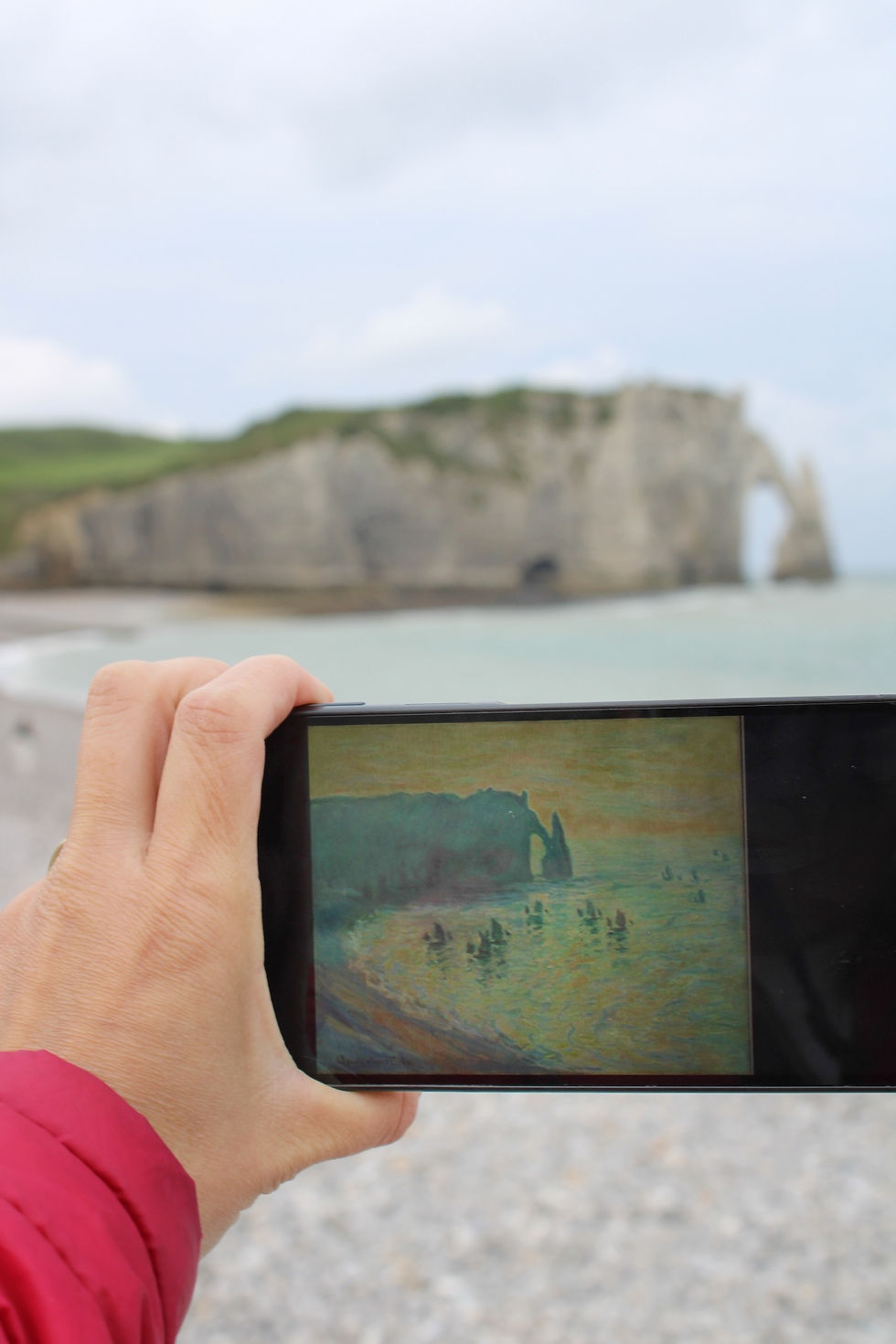
To see the view that inspired The Manneporte, Etretat, climb the cliff path south from the town, over Falaise d'Aval, to find the largest and most majestic of the arches. Monet returned to this specific spot multiple times to capture the sun hitting the stone at different hours, noting how the light changed the cliff from a cold grey to a brilliant gold. Another of his famous works, Rough Sea at Etretat, features the Porte d'Aval and the Aiguille seen from the seafront during a winter storm in 1883. Some of the thatched boats, or caloges, in the foreground can still be seen today, hauled up onto the promenade and transformed into bars.
On the opposite side of the bay is Falaise d'Amont, famously compared by French writer Guy de Maupassant to an elephant dipping its trunk in the sea, and captured by Monet in Étretat: The Beach and the Falaise d’Amont. The steps off the promenade at this end of the beach lead up to the cliff top where you'll find the small Chapelle Notre-Dame-de-la-Garde and Monument L'Oiseau Blanc, a colossal white needle stabbing dramatically into the sky infront of a vast grey aeroplane outline. This memorial is dedicated to two aviators, Nungesser and Coli, who attempted a 1927 transatlantic flight from Paris to New York. They were last seen flying over these cliffs, before disappearing.
Close by, the Jardins d'Etretat are a must visit. This was formerly the Belle Epoque villa home of Monet's close friend, the actress Madame Thebault and today, the space blends avant garde topiary and quirky art installations with views of the cliffs and the seaside village below.
Day 5: Rouen
Drive about 50 miles inland toward Normandy's medieval capital for a change of scenery from the salt air to the lush Seine Valley. Between 1892 and 1894, Monet rented a room in a ladies' clothing shop, separated from the changing rooms by a screen, to paint his famous Rouen Cathedral series. He painted around thirty canvases of the facade (to the point where he wrote to his wife, concerned that he was becoming obsessed) to show how light changes the colour of stone throughout the day.
Now scattered in private and public collections across the world, including Paris' Musee d'Orsay and Musee Marmottan and the National Gallery of Art in Washington DC, you can still see one Cathedral painting at Rouen's Musee des Beaux Arts: Rouen Cathedral: Portal and Albane Tower (Grey weather). Free to visit, this lovely gallery holds the second largest Impressionist collection in France, including Monet's beautiful General View of Rouen (1892), Rue Saint-Denis, Celebration of June 30 and The Seine at Port-Villez, painted near Giverny.
Rouen is a magnificent city and a very rewarding day trip. You can explore the historic centre with 2,000 half-timbered houses (the most in France) and beautiful Gros Horloge astronomical clock, visit the the old market place where Joan of Arc was executed in 1431 and learn about her epic story through brilliant audiovisual reconstructions at the Historial Jeanne d'Arc.
For more key Joan of Arc sites in central Rouen including the castle where she was imprisoned and the strikingly 1970s modern church dedicated to her, check out our guided walking route.
Before you leave, consider booking a table at La Couronne, the oldest inn in France and the restaurant that changed Julia Child's life. Rouen is foodie paradise, a UNESCO city of gastronomy (the only one in France!) and La Couronne offers several gourmet menus that have graced the tables of the rich and famous since 1345. Former guests include Salvador Dali, Grace Kelly, Jacques Chirac, John Wayne, Sophia Loren and Brigitte Bardot. It was here that Child had her first meal in France, inspiring her to teach the world the wonders of French cuisine, and you can still select her exact order: six oysters on the half shell, Dover soul in browned butter and a green salad). Visiting at midday? Order from the "Normandy on a Plate" menu, a very reasonably priced €29 three course set lunch, featuring seasonal local flavours especially selected by the chef, or sample Rouen specialties off the main menu.
Day 6: Giverny and Vernon
Today you will visit the master's sanctuary at Claude Monet House and Gardens, Giverny. Monet lived here for forty three years, from 1883 until his death in 1926, and this is where he meticulously designed his own gardens to paint and created some of his most famous works, including the vast Water Lilies series and the vibrant The Artist's Garden at Giverny. The surrounding countryside also inspired his celebrated Haystacks series and the blossom filled orchard in Springtime at Giverny.

In Giverny, you can explore Monet's beloved pink house with its iconic green shutters, surrounded by the blooms he tended so carefully. As he once said, "I perhaps owe having become a painter to flowers". Walk through the glorious Clos Normand flower garden and the iconic Water Garden with its famous Japanese bridge and waterlily pond. Inside the house, walk through Monet's studio where so many masterpieces were born, the charming blue kitchen and yellow dining room and look out for Boudin's painting of the bell tower in Honfleur hanging on the walls, a tribute to his early mentor. Before you leave, make sure to visit the wonderful gift shop which stocks everything you could ever want to have printed with Monet's art, from stationery to silk scarves.
A short walk away is the Musee des Impressionnismes, home to a wonderful collection including works by Monet, Boudin, Caillebotte and Bonnard, and pause for a coffee on the terrace of the Ancien Hotel Baudy, once the social heart of the village where American artists like John Singer Sargent and Theodore Robinson used to stay. A little further brings you to the Eglise Sainte Radegonde where Monet's grave can be found in the family plot.
Tip: Monet's house and gardens are one of the most popular destinations in Normandy and booking in advance is essential. Try to book the earliest time slot possible right when it opens for a precious window of calm before the larger tour groups arrive, and remember that midweek visits are generally quieter than weekends. The House and Gardens are open to visitors from April - November.
Leaving Giverny, stop in Vernon, just three miles away, to see the Old Mill. Immortalised by Monet in Houses on the Old Bridge, Vernon, it sits on the ruins of a medieval bridge over the Seine and remains one of the most photographed spots in the region. Time permitting, you could also pop into the Blanche Hoschede-Monet Museum (open til 6 pm 1st April - 31st October, til 5 pm 1st November - 31st March, closed Mondays), which provides an essential link to Monet's private life and artistic legacy. Renamed in 2024 to honour the woman who was both his stepdaughter and daughter in law, Blanche was Monet's only student and his most devoted assistant during his final years. Often seen painting alongside the master in the fields of Normandy, she spent over twenty years after his death meticulously preserving his house and gardens for future generations.
The museum is housed in a beautiful fifteenth century mansion and features two original Monet works, including a rare circular Water Lily painting and a sunset view of the cliffs at Pourville. You can also examine Blanche's own Impressionist canvases and a significant collection of works by the American artist colony that flourished in Giverny.

Day 7: Honfleur
Cross back towards the coast to visit this stunning historic fishing town, 75 miles (about 90 minutes drive) from Giverny. This is where a young Monet met Eugene Boudin in 1858, the man who taught him to paint en plein air and where he would return many times.
Visit the Musee Eugene Boudin to see an incredible collection of pre-Impressionist works and stroll around the Vieux Bassin, the old harbour surrounded by tall, slate-fronted houses. Don't miss St. Catherine's Church, the largest wooden church in France, built by shipwrights with a ceiling that looks like an upturned boat hull.
If you're feeling inspired, you could even book a watercolours workshop guided by an artist at Ferme Saint Simeon, the historic inn in the hills above Honfleur where Monet, Boudin and Courbet gathered over local cider to discuss the revolutionary idea of painting in the open air to capture the shifting light of the Seine estuary. Today, the farm is a luxury hotel, but you don't have to be a staying guest to enjoy an outdoor painting class in its historic grounds to experience the same views that inspired Monet's The Road to Saint-Simeon in Winter (enquire via email, €230 per person including lunch).

Day 8: Deauville and Trouville-sur-Mer
Continue half an hour along the coast to the twin seaside resorts of Deauville and Trouville-sur-Mer, separated by a bridge. In the summer of 1870, Monet spent his honeymoon in Trouville. Rather than painting traditional landscapes, he chose to capture the modern, fashionable crowds on the beach, reflecting the new era of seaside tourism. His famous work, The Boardwalk at Trouville, actually has grains of sand embedded in the paint from when he worked on the beach in the wind.

Walk Deauville's famous promenade, Les Planches, lined with iconic Art Deco beach huts named after Hollywood stars and with brightly coloured beach umbrellas on the sand in front. Home to prestigious events throughout the year like polo matches, horse racing and the American Film Festival, Deauville also boasts some stunning Belle Epoque architecture such as the Casino Barrière and the Villa Strassburger. Afterwards, cross the river to Trouville to see the Hotel des Roches Noires, which Monet painted as a symbol of high society.
Day 9: Le Havre
End your journey 50 minutes from Deauville in the city where Monet’s artistic journey truly began. Having moved here as a five-year-old boy, it was on the (now named) Quai Southampton in 1872 that he painted Impression, Sunrise, the very work that gave the Impressionist movement its name. While much of the city was destroyed in the Second World War, it was rebuilt in the 1950s by visionary architect Auguste Perret. This "Poetry in Concrete" is now a UNESCO World Heritage site and a masterpiece of bold, 20th-century design.
Start with a visit to the MuMa (Musée d'Art Moderne André Malraux), a spectacular glass-walled museum overlooking the port entrance. It houses one of France’s most extensive Impressionist collections, including works by Monet, Renoir, and Pissarro, as well as the largest collection of Boudin’s canvases in the world.
Next, take a short drive (or a pleasant half hour walk along the seafront ) to the affluent suburb of Sainte-Adresse where Monet stayed with his aunt in the summer of 1867, to see the views looking out over the English Channel immortalised in his The Beach at Sainte-Adresse and The Garden at Sainte-Adresse.

If you have time to explore before your ferry, Le Havre offers some incredible modern landmarks that contrast beautifully with the historic timber of Rouen and Honfleur. You can step inside Perret's St. Joseph’s Church, more like a concrete skyscraper with a 107 metre lantern tower filled with thousands of pieces of coloured glass that glow like a kaleidoscope when the sun hits. Nearby, you will find the striking, volcano-shaped cultural centre known as Le Volcan, designed by the legendary Oscar Niemeyer. For a more contemporary perspective, look out for the Catène de Containers, which consists of two massive arches made of brightly coloured shipping containers that celebrate the city’s maritime soul. You can also find the UP#3 installation on the beach, a white frame which captures the horizon exactly as the painters once did.
From here, Brittany Ferries operates a route back to Portsmouth. Alternatively, you might also like to consider continuing onto Paris! If you aren't taking the ferry back, Le Havre is the perfect place to drop the rental car. High speed trains run from Le Havre to Paris Saint Lazare, the very station Monet painted extensively. From there, it is a short trip to the Musee de l'Orangerie to see the giant Water Lilies cycles.
Hotel recommendation - Hilton Garden Inn Le Havre:
Right on the front, this hotel is the perfect base for exploring Le Havre: 5 minutes walk from St Joseph's Church and 10 from MuMa or the beach, the entire hotel is elegant, bright and breezy. Our room was on the top floor, with a fridge, sofa and a generous balcony overlooking the marina and the sea beyond. Being western facing, we had two amazing sunsets during our stay and Jamie loved watching the ferries sail past as they arrived and departed the port round the corner. Breakfast was outstanding, with omelettes made to order, several hot options, tropical fruits, pastries, and an impressive cheese selection. The hotel has a gym and a port facing bar, and they provided a travel cot or our room.
We parked for free at the open air car park on Boulevard Clemenceau by Club Nautique Havrais.
10: A Paris extension
While the Normandy coast provided a lot of his inspiration, Paris was also crucial for Monet's vision. He was born in the capital in 1840 on Rue Laffitte and returned at nineteen to forge a career that would change art forever. During his student years, he lived a bohemian life in the city, sharing rooms with Renoir and surviving on a meagre diet while honing his craft at the Académie Suisse. It was here that he and his peers rebelled against the rigid traditions of the official Paris Salon, eventually forming their own society to host independent exhibitions in the 1870s.
If you make the trip to Paris, prioritise these three galleries: the Musée d’Orsay holds a vast collection of his most iconic works, including paintings from the Rouen Cathedral series and his studies of the Gare Saint-Lazare railway station. The Musée Marmottan Monet houses the world’s largest collection of his work, featuring over one hundred masterpieces including the original Impression, Sunrise. Finally, visit the Musée de l’Orangerie to stand in the centre of the oval rooms designed specifically to display the massive Water Lilies cycles that Monet completed in his final years.

Getting around
While we have written this Monet trip as a driving route, if you would rather stay in one place or don't have access to a car, you could still do much of this itinerary by basing yourself in Rouen and taking day trips. The city has excellent train links to Dieppe, Fecamp, Etretat (changing onto bus 509 at Bréauté-Beuzeville), Le Havre, Giverny and Vernon, and Paris.
Car Hire: We took our own car on this trip, but when we hire cars, we book through Discover Cars. They were brilliant for our Great Ocean Road trip - half the price of the major airport kiosks with full insurance coverage -and they’ve since become our go-to, most recently for our road trip around Jeju Island in South Korea. As we start eyeing up the even more rugged terrain of New Zealand for our next big family road trip later this year, Discover Cars will undoubtedly be our first port of call for securing a reliable, family-friendly ride.
Pin this blog for later!


